Category: Uncategorized

  • The US economy added 199,000 jobs in November

    The US economy notched another solid month of job growth, with an added lift from actors and autoworkers coming off the picket lines.

    Employers added 199,000 jobs in November, and the unemployment rate dipped to 3.7% from 3.9% the month before, according to Bureau of Labor Statistics data released Friday.

    “The economy’s still humming along,” Jane Oates, a former Department of Labor official who now is CEO of employment education nonprofit WorkingNation, told CNN. “For the past two weeks, all we’ve heard is doom and gloom about how this is going to be a terrible day. And it was a much better day than was predicted.”

    Economists were expecting net job gains of 180,000 for the month and for the unemployment rate to hold steady, according to Refinitiv.

    The labor force participation rate ticked up 0.1 percentage points to 62.8%, returning to its highest level since the onset of the pandemic. The participation rate increase is a “positive underlying context to the unemployment rate decline,” wrote Daniel Zhao, Glassdoor’s lead economist, in commentary issued Friday.

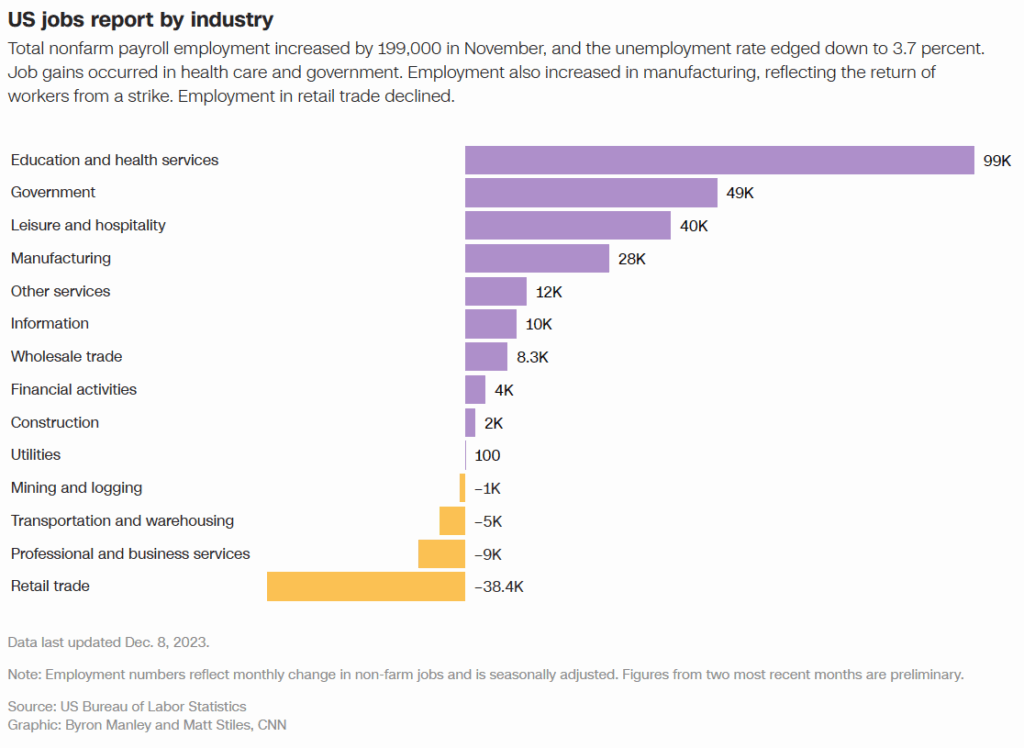
    The largest employment gains last month came in health care and government, which added an estimated 93,200 and 49,000 jobs, respectively. Manufacturing saw a boost, too, largely because of the return of striking autoworkers, which lifted motor vehicles and parts employment by 30,000 jobs.

    Additionally, the resolution of the Screen Actors Guild strike against Hollywood studios resulted in 17,200 jobs added in the motion picture and sound recording industries.

    In total, the BLS was anticipating a net gain of 35,000 workers returning after strikes: The agency estimated that 61,000 workers were absent from the labor market due to labor disputes, versus 96,000 the month before.

    Taking into account those one-time gains, the underlying rate of job growth is likely around 160,000 jobs per month, which aligns with the 2019 average, wrote Julia Pollak, senior economist with ZipRecruiter.

    November’s jobs number is in line with the strong monthly gains hit in the decade before the pandemic, when 183,000 jobs per month were added. The current rate of job growth also is well above the “neutral rate,” or what’s needed to keep up with population growth.

    “It is critical to put this data in the proper context,” Joseph Brusuelas, principal and chief economist of RSM US, wrote in a note on Friday. “Given long-term demographic changes and structural transformation of the US economy to keep employment stable, only 75,000 jobs per month need to be created, in contrast with the roughly 200,000 that was the case just over a decade ago.”

    Retail drop-off

    The biggest declines occurred in the retail trade and temporary help services sectors, which lost 38,400 jobs and 13,600 jobs, respectively.

    “The [reason for the] reduction of jobs in retail is very similar to the reduction of jobs in other places, except retail hasn’t been able to absorb — and that’s technology,” Oates said.

    As e-commerce and in-store pick-ups become more engrained in how people shop, that leads to fewer people needed at the brick-and-mortar level.

    https://ix.cnn.io/dailygraphics/graphics/20230227-bls-monthly-jobs-sectors-live/index.html?initialWidth=910&childId=graphic-20230227-bls-monthly-jobs-sectors-live&parentTitle=The%20US%20economy%20added%20199%2C000%C2%A0jobs%C2%A0in%20November%20%7C%20CNN%20Business&parentUrl=https%3A%2F%2Fwww.cnn.com%2F2023%2F12%2F08%2Feconomy%2Fnovember-jobs-report-final%2Findex.html

    What this means for the Fed

    November’s job growth was stronger than October’s unrevised tally of 150,000 jobs added. September’s job gains were revised down to 262,000 from 297,000, according to the BLS.

    The continued strength in the labor market has helped fuel consumer spending and economic growth, but Federal Reserve officials believe slower demand (and slower wage growth) will help bring down inflation.

    Friday’s jobs report showed that average hourly earnings rose 0.4% in November from the month before, showing a more accelerated pace of growth than the 0.2% uptick seen in October and the 0.3% expected by economists.

    Federal Reserve Board Chairman Jerome Powell speaks during a news conference after a Federal Open Market Committee meeting on November 01, 2023 at the Federal Reserve in Washington, DC. The Federal Reserve left interest rates unchanged at a range of 5.25 percent to 5.50 percent, keeping rates the highest they have been in 23 years.

    Fed Chair Powell: Too early to say when to expect rate cuts

    On an annual basis, however, wage gains eased to 4% from the 4.1% rate seen a month before.

    Through November, the economy has added an average of 232,000 jobs per month — far more moderate growth than 2022 and 2021, when an estimated 399,000 and 606,000 jobs were added every month, respectively.

    Friday’s strong jobs report likely keeps the Fed’s options open, although cooling inflation should mean that another pause is in store when the central bank meets next week, wrote Lydia Boussour, EY senior economist.

    “Labor market endurance will lead Fed officials to retain some optionality for future rate hikes, if needed,” she wrote. “We expect policymakers will resist talking about rate cuts until early 2024.”

  • Russia, Saudi Arabia urge all OPEC+ countries to join group’s agreement on output cuts

    Russian President Vladimir Putin and Saudi Crown Prince Mohammed bin Salman have urged all OPEC+ countries to join the group’s agreement on output cuts, saying it would serve the interests of the global economy.

    The appeal was made in a joint statement published on Thursday after the two met a day earlier and also said that Russia and Saudi Arabia had agreed it was important to boost co-operation in oil and gas, including in equipment supplies.

    Following last week’s OPEC+ meeting, Saudi Arabia agreed to extend voluntary oil output cuts of 1 million barrels per day (bpd) into the first quarter, while Russia said it would continue to curb oil exports by 300,000 bpd and additionally reduce its fuel exports by 200,000 bpd in January-March.

    The total curbs amount to 2.2 million bpd from eight producers, OPEC said in a statement after the meeting last week.

    But not all OPEC+ members agreed to extend or deepen the voluntary oil cuts and the latest statement from Putin and Mohammed bin Salman appears to be appealing to those countries.

    “In the field of energy, the two sides commended the close co-operation between them and the successful efforts of the OPEC+ countries in enhancing the stability of global oil markets,” the statement said.

    “They stressed the importance of continuing this co-operation, and the need for all participating countries to join the OPEC+ agreement in a way that serves the interests of producers and consumers and supports the growth of the global economy.”

    OPEC+’s output of some 43 million bpd already reflects cuts of about 5 million bpd aimed at supporting prices and stabilizing the market.

  • CN announces deal to acquire Iowa Northern Railway

    Canadian National Railway Co. CNR-T +0.47%increasesays it’s acquiring Iowa Northern Railway, pending regulatory review.

    In a press release Thursday evening, CN says it has signed and closed an agreement to acquire the railway, which serves upper Midwest agricultural and industrial markets.

    The Iowa railway operates approximately 275 track miles in Iowa connecting to CN’s U.S. rail network.

    CN says the transaction “represents a meaningful opportunity to support the growth of local business by creating single-line service to North American destinations.”

    Terms of the transaction were not disclosed.

    CN says a decision from the U.S. Surface Transportation Board regarding the decision is expected in the new year.

  • Bank of Canada holds key interest rate steady at 5% in final decision of 2023. Here’s what’s next

    The Bank of Canada held its policy rate steady at 5 per cent for the third consecutive decision and warned that it could raise rates again. It said monetary policy is working to cool inflation but gave few hints that it is preparing to lower rates.

    Markets believe the bank will start cutting rates in the first half of next year.https://charts.theglobeandmail.com/Zn08W/1/

    Find updates from our reporters and columnists below.


    12:15 P.M.

    What’s next?

    Toni Gravelle. the Deputy Governor of the Bank of Canada, is photographed during webcast on June 4 2020.FRED LUM/THE GLOBE AND MAIL
    • Deputy Governor Toni Gravelle will deliver an Economic Progress Report on Thursday outlining the bank’s rationale for today’s decision. The speech in Windsor, Ont., starts at 12:50 p.m. ET, followed by a news conference at 2:10 p.m. ET.
    • The Bank of Canada’s next interest rate announcement is on Jan. 24. It will also publish its quarterly Monetary Policy Report, with updated forecasts for inflation and economic growth.
    • Statistics Canada will release November inflation data on Dec. 19 and October GDP numbers on Dec. 22.
    • The U.S. Federal Reserve’s next rate announcement is on Dec. 13. Most economists expect the Fed to hold interest rates steady but will be watching for any changes of tone that hint at where U.S. monetary policy is headed.
  • Oil steady as markets weigh OPEC+ cuts against Chinese demand concerns

    Oil prices were steady on Wednesday, as investors weighed the effectiveness of an extension in OPEC+ cuts in tightening supply against a worsening demand outlook in China.

    Brent crude futures fell 5 cents, or 0.06 per cent, to $77.15 a barrel by 0900 GMT. U.S. WTI crude futures fell by 16 cents, or 0.22 per cent, to $72.16 a barrel.

    The Organization of the Petroleum Exporting Countries and allies such as Russia (OPEC+) agreed on voluntary output cuts of about 2.2 million barrels per day (bpd) for the first quarter of 2024 late last week.

    Saudi and Russian officials added this week that the cuts could be extended or deepened beyond March.

    But both benchmarks closed at their lowest level since July 6 in the previous session, on a run of four straight days of losses.

    “The decision to further reduce output from January failed to stimulate the market and the recent, seemingly co-ordinated, assurances from Saudi Arabia and Russia to extend the constraints beyond 1Q 2024 or even deepen the cuts if needed have also fallen to deaf ears,” PVM analyst Tamas Varga said.

    Concerns over China’s economic health, which could limit overall fuel demand in the world’s second largest oil consumer, also weighed on prices.

    Rating agency Moody’s lowered the outlook on China’s A1 rating to negative from stable on Tuesday, citing “increased risks related to structurally and persistently lower medium-term economic growth and the ongoing downsizing of the property sector”.

    China will release preliminary trade data, including crude oil import data, on Thursday. Earlier expectations showed China’s refinery runs to have declined in November.

    Russian president Vladimir Putin travels to the United Arab Emirates and Saudi Arabia on Wednesday to meet with the UAE’s President Sheikh Mohammed Bin Zayed Al Nahyan and Saudi Crown Prince Mohammed bin Salman.

    Oil and the OPEC+ agreement will be on the agenda, the Kremlin said.

  • Canada’s financial intel agency imposes $7.4-million penalty on RBC

    Canada’s financial intelligence agency has levied a $7.4-million penalty against the Royal Bank of Canada RY-T +0.59%increase for non-compliance with anti-money laundering and terrorist financing measures.

    The Financial Transactions and Reports Analysis Centre of Canada says the violations include failing to submit suspicious transaction reports where there were reasonable grounds to suspect ties to a money laundering offence.

    The agency, known as Fintrac, tries to pinpoint money linked to illicit activities by electronically sifting millions of pieces of information each year from banks, insurance companies, money services businesses and others.

    It then discloses intelligence to police and other law-enforcement agencies about the suspected cases.

    Fintrac director Sarah Paquet said in a recent speech that the agency’s priority is to work with businesses to help them comply with their reporting obligations.

    But she clearly flagged that some were falling behind and that Fintrac would take appropriate action when needed.

  • OPINION:

    David Rosenberg: Canada is in economic decay. Prepare for BoC rate cuts and big returns in this asset class.

    There may be lies, damned lies, and statistics as Mark Twain posited. But statistics, as flawed as they may be, are all we have to go by. And the statistics show a Canadian economy that very likely has already slipped into a recession, even as Tiff Macklem doth protest too much.

    The Bank of Canada will be singing like a canary within the next several months. The recession here promises to come earlier and be far more severe than what we will see unfold south of the border — that won’t be a pretty picture, either — with negative implications for the loonie, but highly positive implications for the long end of the government of Canada bond market as inflation completely melts away by the time spring arrives.

    Spring refers to the seasonal weather pattern, not the economy, which is going to be feeling a chill for most of 2024 — even as the snow begins to melt, the pace of activity will still be melting.

    But an even more deeply rooted problem is that we have had a government that caused the economy to become addicted to debt and excessive house price inflation, and papered over these problems by promoting an immigration boom. But the issue with the unprecedented population growth is that it isn’t paying for itself (quite the opposite).

    That is my opinion.

    But now, let’s assess the facts: The Canadian yield curve has been inverted since July 2022, and only four other times in recorded history has it been as inverted as it is today. Except for the summer of 1962, every inversion has touched off a recession. But when the negative gap between longer-term bond yields and rates at the front end of the GoC curve was as steep as it is now, the Canadian economy entered a recession 100% of the time. Why are the Canadian banks tightening their credit guidelines and boosting their loan loss provisioning of late? Because they are being forward-looking and see things unfolding just as I do.

    Economic decay is already underway. Real GDP growth in Canada has slowed markedly on a four-quarter trailing trend basis from a hot +4% pace a year ago to a chilly +0.5% as of the third quarter, as fiscal stimulus lags fade away and the bite from the radical tightening in monetary policy lingers on. This is a stall-speed economy and is either in recession or rapidly approaching one. When you adjust for the immigration-fueled +2.7% population boom, what this means is that the economy, in real per-capita terms, has contracted -2.2% over the past four quarters. You can only camouflage the dismal economic reality via unprecedented inbound migration flows for so long.

    Putting this dismal economic situation into its proper context, Canadian GDP growth, given this population boom, “should be” expanding at over a +4% pace. But it isn’t — it is as flat as a beavertail. Statistics Canada estimates that Q3 real GDP contracted at a -1.1% annual rate which offset most of the tepid +1.4% uptick in the second quarter. Tack on the fact that industrial production has been flat or negative in each of the past four months, and in five of the past six, and the year-over-year pace has been slashed to -1.3% from +5.4% a year ago. That is a massive swing in a deeply cyclical part of the economy.

    Even the once-hot service sector has cooled off in dramatic fashion: the year-over-year trend here was clipped to +1.6% as of September, about half the +3.1% year-ago trajectory.

    The buildup of recessionary pressures is unmistakable, and yet the Bank of Canada seems to be whistling past the graveyard. Only the bond market seems to have figured it out, but what else is new?

    Real Gross Domestic Income (GDI), meanwhile, paints an even darker picture. This metric of economic activity has contracted in four of the past five quarters and is down nearly -1% on a year-over-basis, even with the population bulge. This metric tells us that there is an 80% chance the recession that no Bay Street economist sees has already begun! I hate to break the news to the Bank of Canada, but I am sure it is aware of this fact even if it won’t address it publicly. More important to Tiff Macklem & Company is fighting yesterday’s inflation battle. Plus ça change, plus c’est la même chose. Disciples of John Crow, for those with long enough memories of how things looked back in the early 1990s.

    The fallout from the gap between population growth and the real economy is visibly seen in the woeful productivity performance, which definitely is in a recession of its own. After years of inept government policy that fueled a housing and consumer debt boom instead of nurturing expansion in the private sector capital stock, we are left with productivity declining for five consecutive quarters and down -1.7% from year-ago levels. If I were Pierre Poilievre (very likely the country’s next prime minister), I would try and teach Canadian voters in the coming campaign trail how critical it is to promote policies that enhance productivity growth — the critical ingredient for any country’s long-run growth potential and vitality. Instead, Canada has focused its supply-side policies on massive immigration which has been largely responsible for the housing shortage and affordability crisis the country now confronts. Having been around the track for a while, I don’t think it would be a stretch to declare that we have not seen a government in Ottawa understand the basic economic concept otherwise known as “capital deepening” and the link to multi-factor productivity growth since the excellent Brian Mulroney-Michael Wilson tag team in the second half of the 1980s.

    Instead of promoting productivity and capital investment,the Canadian government for years, if not decades, has pursued policies aimed at spurring a housing and credit bubble of epic proportions, and now it is time to pay the piper. Household debt relative to disposable income has mushroomed to 172% — that is about 30 percentage points higher than the epic credit bubble peak in 2006-07 in the U.S. that brought the house down (both literally and figuratively). Remember — this is an aggregate statistic. The number is even higher when you consider that nearly one-third of Canadian households are debt-free — for the other two-thirds, a dire situation has taken hold. Delinquency rates are on the rise and the banks are now being forced to bolster their loan loss reserve provisioning in anticipation of a recessionary default cycle.

    We have reached the point where nearly 15 cents of every after-tax dollar are being drained from household pocketbooks to service the mountain of debt — right where this ratio was prior to the 2001 and 2008 economic downturns. In fact, the total debt-service ratio for the personal sector is higher now than it was in the spring of 1990 when it was 12.7% — Canada was in the midst of a horrible recession back then. But what is key is that the BoC policy rate was 13% at a time when the household debt ratio, at 89%, was about half of today’s disturbing level. Today, we have a 5% interest rate doing the damage a 13% interest rate used to unleash because of the fact that the debt has ballooned as much as it has.

    This debt bubble is now set to unwind, and likely not in a very orderly fashion. And the property bubble is already being burst —the YoY trend in the new house price index moving from +11.5% two years ago to +5% a year back to nearly -1% currently. There is so much air underneath the residential real estate market that just to mean-revert the homeowner affordability ratio wouldrequire a 20% plunge in home prices — and that is a conservative estimate.

    The deflation underway on the largest component of both household and banking sector balance sheets promises to be spectacular — as the peak impact of the damage the BoC has unleashed still lies ahead of us. This is by no means an exaggeration and is only problematic for those who aren’t prepared.

    What promises to make the situation more acute is that as unemployment rises, we can expect nominal wage growth to slow — the denominator in that debt/income quotient. We already are seeing the early signs of a contraction in credit, evident in the fact that the growth in total household debt and residential mortgages has slowed in the past year to +3% (negative in real terms). This is the weakest trend in two decades, if not more. There is absolutely nothing inflationary about the declining trajectory we are seeing in both money and credit — in fact, I sense thatthis time next year we will be back to talking about deflation and the BoC will be singing like a canary as most, if not all, of the rate hikes since the spring of 2022 is unwound.Seriously, what is there in theory or practice that leads to anything but disinflation (or even deflation) from these sharp downtrends in both money and credit? Is the central bank even aware of what its own data are revealing?

    Now what about the labour market? While job growth has continued to this very day, the fact of the matter is that Canadians, now facing the end to Covid-era fiscal goodies and a rising debt-servicing burden, are coming back into the labour force in droves. The labour force has expanded at a +3.3% annual rate over the six months to November, well above the +2% pace of job creation (though the overall expansion in labour input is far lower than that, seeing as the workweek has been cut -0.4%). What this has done is trigger a huge +147,000 run-up in the ranks of the unemployed, one of the biggest increases in joblessness over a six-month interval since September 2020. The YoY trend in unemployment is at over +16% and, like the inverted shape of the yield curve, is another sure-fire recessionary signpost. The widening differential between the number of folks re-entering the labor market in search of a job and the actual number of positions being absorbed has precipitated a notable rise in the unemployment rate to 5.8% from the cycle low of 4.9%. While some may claim that 5.8% is still a “low number,” what matters most is the change, not the level. Not once in the past seven decades has Canada escaped a recession (NBER-defined downturn, with no intended disrespect to the C.D. Howe Institute) with a 0.9 percentage point increase in the jobless rate from the cycle trough.

    The Bank of Canada has unleashed a whole whack load of pain on the Canadian economy and, so far, has shown no sign of reversing course. Never mind that once shelter is removed from the CPI data, particularly the bizarre inclusion of mortgage interest costs (+31% YoY), the inflation rate is sitting below target at +1.9%. This time last year, this underlying inflation rate was hovering just below +7%. Before Covid struck, back in February 2020, that inflation rate was +2.1%. It is now running below that mark!

    The unemployment rate back in February 2020 was 5.7% and now it is 5.8%. And yet, despite the jobless rate being higher, and the lower underlying inflation rate, the policy rate today sits at 5.0% whereas it was 1.75% back then. And the 10-year government of Canada yield was sitting at half of today’s 3.5% level — hence our continued bullish stance on the bond market.

    A bull-steepener – when the short-end of the yield curve falls faster than the long-end – is the theme for 2024, with the greatest total return potential at the long end of the GoC curve.

    David Rosenberg is founder of Rosenberg Research, and author of the daily economic report, Breakfast with Dave.

  • AltaGas to raise quarterly dividend for 2024 as company expects earnings to grow

    AltaGas Ltd. ALA-T +0.51%increase is raising its dividend as it says it expects its earnings to grow next year, helped by its core operations.

    The energy infrastructure company says it will pay a quarterly dividend of 29.75 cents per share starting with its March payment to shareholders, up from 28 cents per share.

    In its outlook, AltaGas says it expects its normalized earnings per share for 2024 to total between $2.05 and $2.25.

    The result would mean year-over-year growth of about 10 per cent, based on the midpoint of its guidance for both years.

    The company says its capital spending plan for 2024 is expected to be $1.2-billion, excluding asset retirement obligations.

    AltaGas shares closed down 39 cents at $27.33 on the Toronto Stock Exchange on Monday.

  • Job openings slide to 8.7 million in October, well below estimate, to lowest level since March 2021

    • Job openings openings totaled 8.73 million for the month, a decline of 617,000, or 6.6%, the Labor Department reported Tuesday in its monthly JOLTS report.
    • That was the lowest total since March 2021 and brought the ratio of openings to available workers down to 1.3 to 1.

    Job openings slide to 8.7 million in October, well below estimate, to lowest level since March 2021 (cnbc.com)

  • Gold soars past $2,100 to new record — and analysts don’t expect it to stop there

    • Spot gold prices rose to a new record high of $2,110.8 per ounce Monday before giving up some gains.
    • Prices of the yellow metal have risen for two consecutive months with the Israel-Palestinian conflict boosting demand for the safe-haven asset.
    • Gold prices are expected to remain above $2,000 levels next year.

    Gold prices at record highs amid economic, geopolitical uncertainty (cnbc.com)